Backend Falls First, Not Frontend: The Real Order of AI Replacement Across the Stack
Every tech forum is full of takes like "AI killed frontend" and "Cursor wrote a landing page overnight, frontend is over."
This is the biggest misread of 2026. What AI is replacing fastest is not frontend — it's backend. And the discipline most people think is "just writing code" — native client — is actually being replaced the slowest. The order is completely counter-intuitive:
Backend > Frontend > Native Client (fastest to fall) (slowest to fall)
Why? Because AI replacement speed isn't determined by "how hard the code is". It's determined by something else: whether the full work loop can close in pure text.
Real Numbers First: How Much Does AI Coding Actually Help?
The "5x" you see in social feeds is anecdote, not data. Here is what controlled studies actually measured:
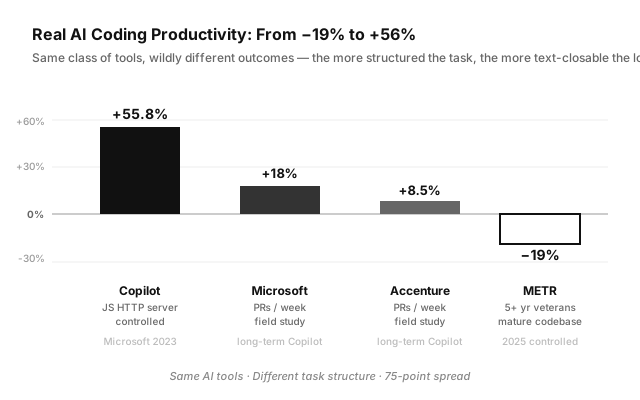
- Microsoft / GitHub 2023 controlled experiment: JS HTTP server task — Copilot users were 55.8% faster than the control group. Structurally, that benchmark is a textbook backend CRUD.
- Field experiment from the same paper: long-term Copilot users at Microsoft shipped 13-22% more PRs per week; at Accenture, 8-9%.
- METR 2025 controlled experiment: working on open-source projects they had 5+ years of experience on, developers using AI were actually 19% slower — yet they felt they were 20% faster (a 40-point gap between perception and reality).
Same class of AI tools, wildly different outcomes: +56% to −19%. Why? Because the task structure — how text-closable its work loop is — varies enormously. An HTTP server task (strong contracts, easy verification) is a clean loop for AI; maintenance on a mature codebase (implicit constraints, fast personal feedback) is the opposite, and AI actively slows it down.
Generalize that principle across frontend / backend / native, and you get the central thesis of this post.
The Mechanism: How Text-Closable Is the Loop?
Every engineer's day is the same loop:
write code → run → verify → fix → run again
How fast AI replaces you depends on whether it can run that entire loop by itself — no human in the middle. The three disciplines diverge here:
| Loop step | Backend | Frontend | Native Client |
|---|---|---|---|
| Write code | Pure text ✓ | Pure text ✓ | Pure text ✓ |
| Run | curl / unit test ✓ |
dev server, needs browser ⚠️ | Xcode build + simulator ✗ |
| Verify | Read response / logs ✓ | Read screenshot (AI weak) ⚠️ | Real device / profiling ✗ |
| Fix | Text diff ✓ | Text diff ✓ | Text diff ✓ |
| Ship | git push / Docker ✓ |
Static hosting ✓ | Signing / TestFlight / App Store ✗ |
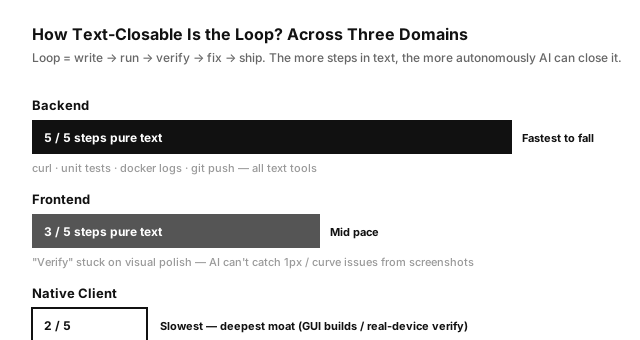
The more the loop is pure text, the more autonomously AI can close it. Backend is 5/5 pure-text; native client is 2/5 pure-text — and that single fact decides the order.
Backend: Fastest to Be Replaced
Backend engineers love to push back: "We do distributed systems, high concurrency, production debugging — AI can't handle that."
Wrong. 95% of backend engineers are not doing distributed systems — they're doing CRUD plus business orchestration. Given a spec: write a read endpoint, write a writer, fan out an event. The training corpus for this is tens of millions of lines on GitHub. Today Claude / Cursor can:
- Read an OpenAPI spec → generate handler + unit tests + integration tests
- Verify the response shape with
curlitself - Read Docker logs to localize errors
- Run a migration, then query the database to self-verify
- No human needs to watch.
Backend is a perfect fit for AI: strong typed contracts + CLI tooling + text logs. By end of 2026, 70% of the daily workload of a 1-3 year backend IC (write endpoints, modify business logic, add caching, run migrations) can be closed by an AI agent on its own.
Timeline: from H2 2026, junior-to-mid backend ICs see 50%+ workload compression. Survivors are the ones who actually understand distributed systems, data, or SRE.
Frontend: In the Middle, Trapped by the "Polish Death Loop"
Frontend code generation quality is actually the highest of all three — React / Tailwind / CSS has a massive training corpus; AI writes a landing page faster than a backend handler. But frontend has a curse backend doesn't have: visual polish cannot be verified in pure text.
What this looks like:
- AI ships a component — it works, but "looks slightly off" — font size off by 1px, animation curve wrong, spacing ratio off
- AI looking at a screenshot itself: can't tell — it identifies "there's a button," but not "the button's visual weight is wrong"
- Designer review: requests 20 micro-adjustments
- AI can make every micro-adjustment, but a human must initiate and approve each
The result is the famous 80/20 death loop: the first 80% of code takes one hour; the last 20% of polish takes eight. And that 20% always needs human judgment.
Add brand consistency, animation curves, accessibility, cross-browser/device adaptation — none of these are loops AI can currently close alone. Frontend won't be replaced by AI directly; it will be replaced by "people who can do code AND design taste" — and those people are rare.
Timeline: 27-28, pure implementation frontend ICs see 50% workload compression. Survivors are full-stack-leaning frontend engineers who understand business and have design taste.
Native Client: Slowest to Be Replaced — The Veterans' Moat
Native client engineers are this round's biggest survivors. Not because their code is harder — because the entire workflow is deeply hostile to AI:
1. Build chain is GUI-based
iOS builds go through Xcode (GUI), Android through Android Studio (GUI), signing through certificates / Provisioning Profiles / Keychain (GUI). An AI agent running in a Linux container can't even start a build — and even with a macOS runner you still hit "untrusted developer" dialogs, Apple ID 2FA, and a pile of GUI gates.
2. Verification depends on a real device or simulator
Backend "verify" = curl localhost:8080. Native "verify" = boot the simulator (10s) → install the IPA (30s) → drive the UI to the target flow (human or script) → look at the UI. Slow yes, but the killer is: AI doesn't actually understand what the simulator UI looks like. Multimodal screenshot reasoning is nowhere near replacing a human QA.
3. Training corpus is naturally scarce
Swift / Kotlin / Objective-C / Java (Android) code volume on GitHub is a small fraction of JavaScript's. The 2024 GitHub Octoverse report lists the top 10 active languages as Python, JavaScript, TypeScript, Java, C#, C++, PHP, Shell, C, Go — Swift, Kotlin, and Objective-C don't appear at all. AI's intuition on native code is far less accurate than on React. "Compiles" ≠ "doesn't crash on iOS 18 / Android 15."
4. Platform policy is a moving target
WWDC / Google I/O ship breaking API changes, forced deprecations, signing rule changes every year — and these take 6-12 months to surface in AI training data. By the time AI learns it, you've been delisted by Apple.
5. Hardware integration is complex
Camera permissions, secure enclave, sensors, Bluetooth, push tokens — each has OS-version and vendor variations, and without a real device AI can only produce code that "looks right" and crashes everywhere.
Timeline: senior native engineers are essentially risk-free through 2029. This is the most underrated anti-AI moat in tech today.
When Do the Defenses Fall?
Not never. Each discipline's defense falls when a specific trigger flips:
| Domain | Trigger that breaks the defense | Distance from now |
|---|---|---|
| Backend | Natural-language → SQL / REST tooling matures | happening now |
| Frontend | Figma → code + auto-polish loop closes | 1-2 years (v0 / Cursor + Figma already showing the seed) |
| Native client | Full-auto CI + cloud simulators + multimodal real-device understanding | 5+ years, no sign yet |
If you're picking a direction now, don't pick "what's easy" — pick what's furthest from a pure-text loop. The further away it is, the harder AI gets in, the safer your job stays.
Concrete Actions for 3 Audiences
Backend: Move Up Immediately
If your day is still writing CRUD, modifying business logic, adding caching — your work is being eaten by AI in real time. Specific upward moves:
- Data / Distributed: Actually understand data modeling, consistency, sharding, CDC
- SRE / Observability: Localizing production incidents is something AI can't do yet
- Architecture / Interface Design: The value is in writing specs AI can't independently complete
- Platform / Internal Tooling: Build internal platforms that other engineers use; AI is your leverage, not your replacement
Stop racing "who codes faster" — AI is 5x faster than you. Race "who decides correctly" instead.
Frontend: Build Taste and Business Sense
- Reading a Figma file is not taste — being able to say "this spacing ratio is wrong, the curve should be ease-out not ease-in" is taste
- Learn to write design specs for AI — your value shifts from "implementer" to "the one who directs AI to implement"
- Lean full-stack on business side: understand what PM actually wants, be able to argue with designers, be willing to refuse a bad spec
Pure implementation frontend roles will be hard to find in 27-28. The window to pivot is open now.
Native Client: Hold the Moat, Don't Let AI In
Your real moat isn't your coding skill — it's your tolerance for fragmentation complexity. Reinforce it actively:
- Deepen platform knowledge: Digest every WWDC / I/O immediately — stay 12 months ahead of AI training data
- Master hardware + performance profiling: Instruments / Android Profiler — GUI tools are your anti-AI weapon
- Don't drift into "web hybrid" — Flutter / React Native is exactly the death spiral pulling you back into frontend / backend territory
Your scarcity goes up, not down, over the next 3 years. Hold the line.
Closing: Don't Get Fooled by "Which Is Simpler"
The biggest fallacy in tech in 2026 is using "code difficulty" to predict "AI replacement risk."
The real formula:
Replacement speed = text-closability of the loop × feedback velocity ÷ platform complexity
Backend scores highest in this formula, so it gets replaced first. Native client scores lowest, so it holds longest. Frontend sits in the middle, trapped by the visual polish loop.
If you're a 30-year-old engineer choosing direction, the right question isn't "which is interesting" — it's: in five years, can AI close the loop on this work by itself? If yes, start pivoting now.
To the veterans: this is the last time in your career when you'll have ample time to choose calmly. There is no next window.