The Hardest Part of Rolling Out AI Coding Isn't Tech — It's Two Kinds of Old-Timers
My team is 20 people. For the past year I've been the one pushing AI Coding into it. The blocker was never technology — the technology has been ready for a while. It was people.
More precisely, two specific kinds of people. Chinese dev circles have a name for them now: 老登, roughly old-timer — the guy who's been around long enough to stop learning and still expects deference. Age has nothing to do with it. They come in two shapes with the same kill radius:
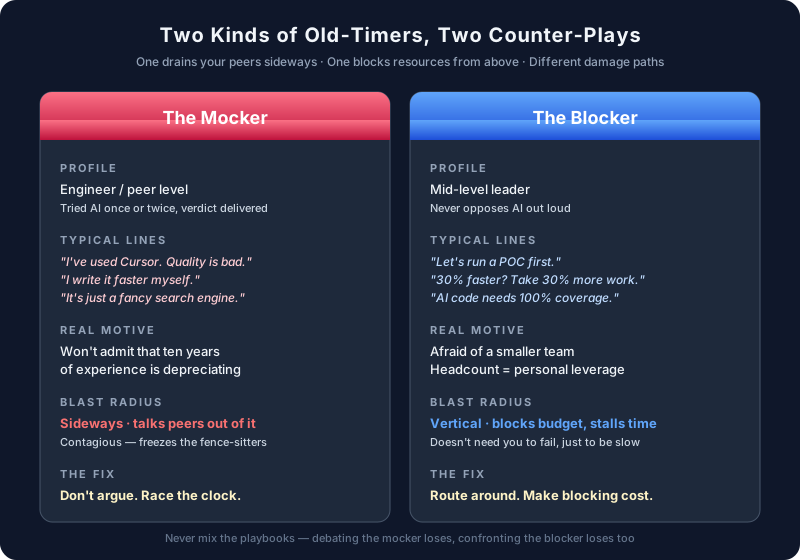
- The mocker: used Cursor once or twice, pointed it at some legacy code, got burned, and now tells everyone they meet that "AI is wildly oversold, it just doesn't work"
- The blocker: usually a mid-level leader. Never opposes AI in private. In public they won't approve budget, won't let AI gains count against timelines, and keep stalling on "quality risk" and "compliance review"
One talks your colleagues out of it sideways. The other blocks resources from above. If you're pushing AI Coding and one of these has stalled you, this one's for you.
Type One: The Mocker
The path is always the same:
- Monday: their manager tells them to "give Cursor a try"
- Tuesday: they point AI at an undocumented chunk of legacy business logic; AI breaks three unrelated things along the way
- Wednesday: a production bug shows up, unrelated to anything AI touched, but they attribute it anyway
- Thursday: posts in the team channel — "I looked at the AI output, quality is mediocre, faster to write it myself"
- Friday: repeats that exact sentence three more times, at their desk, at lunch, in the kitchen
They used AI wrong — and they ran their one failed experiment in the worst possible scenario for it: undocumented legacy code, no context supplied, no task decomposition, no review rhythm. Then they used that experiment to rationalize a conclusion they already wanted: I don't have to change.
There's data on this. AI Coding is an extremely polarized skill. Across the throughput distributions I've seen in several teams, the gap in monthly effective output between engineers who are good at it and engineers who aren't runs 5-8x. That's not "the good ones are 30% faster." That's an order of magnitude.
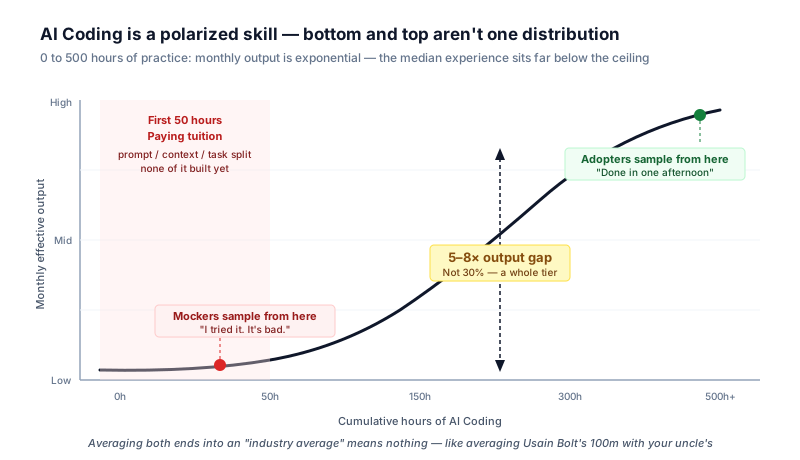
Look at the shape of that curve. It isn't linear, it's exponential. Two consequences:
One: the median experience is bad. AI Coding is not a "gets better the more you use it" tool. It's a "feels useless right up until you're good at it" tool. Most people spend the first 50 hours paying tuition — bad prompts, no context, tasks not broken down, no review rhythm. Of course the output is bad. Which is exactly why mockers can always find a sample that supports them: the genuine beginner sample really is terrible.
Two: the good ones and the bad ones aren't in the same distribution. The "AI knocked out a week of work in one afternoon" post you see online and the "AI really doesn't work" you hear across the aisle are not describing the same population. Averaging them into an "industry average" produces a number that means nothing — like averaging Usain Bolt's 100m with your uncle's and reporting the mean.
The mocker's real motive isn't "AI is bad." It's "AI has to be bad, or the last ten years of my experience just depreciated." That's the strongest variant of confirmation bias there is. Show them data, they say "I've used it." Show them a case, they say "your scenario is special." Logic doesn't beat a position.
Worse, mocking is contagious. One old-timer saying "AI doesn't work" three times in an open-plan office and the junior next to them who was on the fence quietly stops learning — people default to following the senior's read, especially on uncertain topics. That's why the mocker's damage is horizontal: they don't need to stop you, they only need everyone around you to stay still.
Type Two: The Blocking Leader
The blocker is harder than the mocker, because they're usually not stupid, and they never say a word against AI.
After watching a few of them, three tells:
Tell 1: permanently in "evaluation." You show them results, they say "let's do a POC first." POC done, they say "let's do a more rigorous POC." Rigor done, they say "let's wait for the reorg to settle." Every step is reasonable on its own. Stacked, it's infinite delay.
Tell 2: they book the AI gain against the engineers. "You're 30% more productive with AI, so everyone takes 30% more work." That one sentence zeroes out the gain — engineers immediately stop wanting to use it. Next time they push any tool at all, nobody tries it seriously.
Tell 3: quality risk, infinitely amplified. One bug in AI-written code counts like ten bugs in human-written code. AI code must hit 100% test coverage — human code never had to. Senior engineers must review AI output line by line, when no junior's PR was ever scrutinized like that in the history of the team. That double standard isn't about quality. It's fear that AI actually works.
So what's the real motive? Most of the time it isn't quality — it's that team size equals personal leverage.
A mid-level leader's core KPI is how many people they manage and how much budget they hold. If AI lets 3 people finish 5 people's work, that means layoffs, transfers, a smaller org — and the first position that hits is their own. They will find "reasonable" grounds to delay. Every time.
This isn't a conspiracy theory. Several McKinsey and BCG generative-AI adoption surveys over the past two years land on the same conclusion: the layer most resistant to generative AI is not frontline engineers and not the CEO — it's middle management. They don't get the direct tool benefit the frontline gets, and they don't get to absorb headcount reduction as strategy the way the top does. Squeezed from both ends, of course they resist hardest.
The dangerous thing about a blocker: they don't need you to fail, they only need you to be slow. Slow you by six months and the window closes, the industry average moves up, your team's numbers stop looking impressive — and now they have fresh ammunition: "see, it didn't do much."
How to Handle Them: Two Playbooks, Never Mixed
The counters are completely different. Mix them and you lose.
Against the Mocker: Don't Argue, Race the Clock
The worst thing you can do with a mocker is reason with them. Their problem isn't logic, it's position — and you can't solve a position problem with logic.
Exactly one thing works: let them watch something happen that they couldn't have done themselves, and measure only time, never quality.
Concretely:
- Pick a business module they know well — stay out of unfamiliar territory or they'll blame the scenario
- Same task: them writing it vs. AI plus your review
- Compare the clock — 4 hours for them, 45 minutes for AI plus you. They can nitpick the quality. They can't nitpick the clock.
Don't try to convert every mocker. 80% of them won't change, because the core problem is that they don't want to change, not that they haven't seen the evidence. Your goal is separation, not persuasion: get the bystanders — especially the mid-level engineers still on the fence — to realize that standing still means falling behind. That's the whole objective.
The mockers get selected out on their own. Same team, the people using AI well triple their output while they stay put; the gap will make the argument for you inside six months, a year at the outside.
Against the Blocker: Route Around, Never Head-On
A blocking leader usually outranks you, and a head-on fight is a probable loss — they have institutional tools (review boards, compliance, process) and you don't.
The better strategy is to route around them using results:
- Ship something first in a place they don't control — an internal tool, a cross-team collaboration, a side project. The point is routing around their approval chain
- Make the numbers hard: ship date, bug count, output per head, customer satisfaction — all quantified, all comparable against their team
- Report directly to their boss or a peer org — make the cost of blocking exceed the cost of allowing
- Wait for the wind to change — the moment the CEO talks AI strategy at an all-hands, they'll be the first to stand up and "actively embrace" it
The essence of this playbook: you don't need to convince the old-timer leader, you need to turn them into a cost. When not pushing AI is riskier than pushing it, they'll turn on their own — faster than anybody.
One counterintuitive point: never make a blocking leader look bad in public. The harder you embarrass them, the harder they push back, and they have more resources to push with. Let them "come around" in front of the data, hand them a way to save face, and they become your most enthusiastic supporter — because they need that story to explain their own reversal.
To the Person Doing the Pushing: You're Not Immune
The last one matters most. Old-timer is not an age. It's a posture.
I've met 28-year-olds already mocking AI ("I'm faster by hand," "it's just a fancy search engine"), and 50-year-olds who read Anthropic and OpenAI release notes every week and build their own agent harness to orchestrate Claude Code. The difference is whether you're willing to admit your own experience is depreciating.
A quick self-check:
- When did you last pick up a new tool on your own initiative? Over 3 months — warning
- Did you use AI this month for a task you weren't sure you could pull off? No — warning
- When you hear "AI doesn't work," is your first reaction "yeah, true" or "what did they do wrong"? If it's the former — warning
Three for three and you're already on your way.
The scary thing about old-timers isn't the stubbornness, it's how good they feel about themselves. The mocker thinks they've "seen through the marketing bubble." The blocking leader thinks they're "shielding the team from risk." Both believe they're the clear-eyed minority. That feeling usually survives right up until the KPI takes it away.
Closing
At the industry level, AI Coding adoption is past the inflection point. The signals are all around you — "proficient with Cursor / Claude Code" moved from a plus on a resume to table stakes, offers now describe AI-productivity KPIs, team OKRs carry AI tool adoption rates directly. All saying the same thing: the window for tolerating mockers and blockers is closing.
You don't have to eliminate old-timers. You just have to prove AI's value one step ahead of them, and the market and the KPI will handle the rest.
The only thing genuinely worth watching for is not becoming one yourself. The first two have counters. The third doesn't — because nobody is going to walk over and tell you that you already are one.