Digital Coders Explored: An Overhyped Narrative on Top of Under-Built Engineering
Tech feeds are full of "Our AI digital engineer is live" and "24/7 AI programmer, replaces 100 headcount." Open the link: it's a chatbot with an avatar and a name.
But "AI digital engineer" isn't just a marketing word to discard. There's real engineering buried under it: persistent identity, long-term memory, autonomous loop, collaboration interfaces. Solve them and you get an organizational productivity step-change. Skip them and you're selling a chatbot dressed as an employee.
This post pulls the two layers apart: what's overhyped narrative, what's under-built engineering.
Digital Engineer = AI Agent + 4 Things
If "AI digital engineer" has a serious definition, it's not "AI that looks like a human." It's an AI agent layered with these four things — drop any one, and what you have is a chatbot:
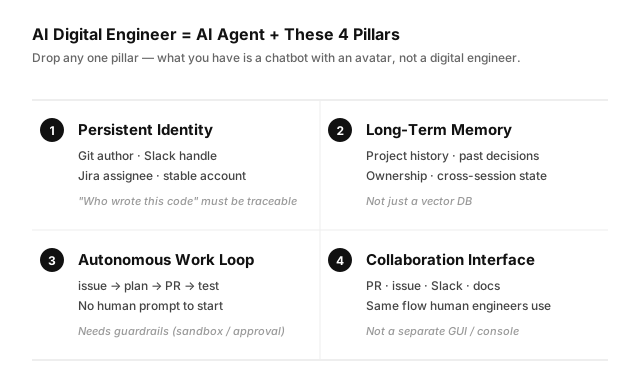
1. Persistent identity: a Git author, a Slack handle, a Jira assignee — not a session-scoped temporary account that vanishes when the chat closes.
2. Long-term memory: knows your project's history, past decisions, last time we changed this and why, who owns what. Not just a vector DB — structured organizational knowledge.
3. Autonomous work loop: doesn't need a human prompt. Sees an issue → evaluates → writes a PR → runs tests → requests review.
4. Collaboration interface: interacts via PRs, issues, Slack, docs — the same flow human engineers use, not a bespoke GUI.
90% of products marketed today as "AI digital engineer" satisfy only 1-2 of these; the rest is UI packaging.
Real Data: Devin Is the Closest Product Right Now
Take Devin — currently the closest real product to the digital-engineer definition. Public 2025-2026 numbers are informative:
- PR merge rate rose from 34% to 67% year-over-year — doubled, but 33% of Devin's PRs still don't merge
- At Goldman Sachs, Devin runs in parallel with 12,000 human developers; the CIO's stated number is a "hybrid workforce ~20% efficiency gain"
- Devin 2.0 dropped from $500/month to $20/month, while Cognition raised at a $25B valuation
Two signals hide in those numbers:
- Real productivity gain ≈ 20% — closely matching the Microsoft Copilot field experiment's +18% PRs/week. Not 5x. Not 100 HC.
- Digital engineers are still assistants — a 67% merge rate means 1 in 3 PRs gets rejected or abandoned. "Fully trusted to work independently" is still a real distance away.
The Five Current Forms: A Capability Matrix
Sorted by how many of the 4 pillars each satisfies, the current product spectrum looks like this:
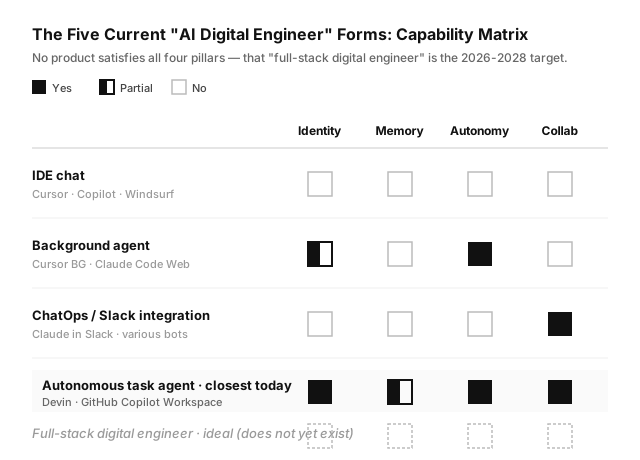
- IDE chat (Cursor / Copilot / Windsurf): code-writing tool, satisfies essentially none of the four — not actually a digital engineer
- Background agents (Cursor Background Agents / Claude Code Web): adds autonomy, still session-scoped, no long-term memory
- ChatOps / Slack integration (Claude in Slack, various bots): strong collaboration surface, weak autonomy and memory
- Autonomous task agents (Devin / GitHub Copilot Workspace): autonomy + partial identity + partial memory — the closest current form
- Full-stack digital engineer (ideal): all four pillars + org-level permissions + accountability — does not currently exist, but it's the real 2026-2028 target
Overhyped: 3 Common Narrative Traps
Trap 1: "24/7 AI engineer"
Reality: agents can run 24/7, but every PR still queues up behind human reviewers. If your bottleneck is review, not coding (see the productivity metrics post), 24/7 is fake busyness — you're just accumulating review debt faster.
Trap 2: "Replaces 100 headcount"
Reality: the best measured numbers from Devin / Copilot Workspace are ~20% org-level productivity gain. A 30-person team × 20% = 6 HC equivalent, not 100. "Save 100 HC" is a CEO story, not engineering reality.
Trap 3: "AI digital engineer = AI agent + avatar"
Reality: avatar, name, virtual persona are zero-value packaging. Slap an avatar on ChatGPT and it doesn't become a digital employee — no persistent identity, no long-term memory, no autonomous loop. Demo layer, not production layer.
Underrated: 3 Real Engineering Problems
Problem 1: Accountability
An AI digital engineer's code causes a production incident. Who's responsible? The "digital engineer" account that submitted the PR? The human who approved it? The one who deployed? The PM who wrote the spec?
Legal, compliance, SRE — none have answered yet. Until this is solved, "digital employees" remain tools in the legal sense — meaning every piece of "AI employee" marketing has no legal weight.
Problem 2: Long-term memory isn't a vector DB
The 2026 state-of-agent-memory writeup names this the memory wall: mainstream AI coding tools forget everything the moment a session ends.
Real long-term memory needs a three-tier architecture:
- Hot memory — project constitution / team conventions / always loaded
- Domain specialist — task-specific expert agents invoked on demand
- Cold memory — knowledge base / historical decisions / retrieved as needed
Without this structure, "digital engineers" start from zero every session — equivalent to a new hire's first day, every day. This is why many teams "deploy a digital engineer" and see no productivity change.
Problem 3: Guardrails for autonomous loops
An unattended agent can:
- Migrate the prod schema
- Force-push to main
- Spam the issue tracker talking to itself
- Burn tokens / API spend through the ceiling
Guardrail engineering is the real watershed for product-grade digital engineers. Cursor, Claude Code already work on it (sandboxes, approval gates, rate limits), but there's no unified standard. This is the most underrated engineering direction in the space.
Concrete Actions for 3 Audiences
Engineers: Master Agents, Don't Get Spooked by "Digital Engineer"
"Digital engineer" is a story for your boss — not a term engineers should use. What you should learn is how to extract real gains from agents:
- Write good specs / prompts (the new "coding skill")
- Configure guardrails (sandboxes, approval gates, pre-flight tests)
- Decide which PRs to trust (first-pass success rate is the real signal)
Managers / TLs / VPs: Decide — Digital Employee, or Engineering Uplift?
90% of the demand is engineering uplift — give the team good tools, fix the review flow, adjust incentives. You get ~20% gain. Mature path, controllable.
10% of demand is actually for digital employees — long-running autonomous AI workers, which touches legal, security, IT, HR, culture change. Don't procure "digital engineer" products before deciding which problem you're solving — that converts an engineering problem into an organizational one.
AI Coding Founders: Beware the Demo Trap
Investor demos featuring "AI colleague debating code in Slack" look amazing but solve no production problem.
The real money is in the 3 underrated engineering problems: accountability, long-term memory, guardrails. Whoever first ships "AI work with clear ownership + reliable cross-session memory + safe autonomous loops" as a foundational layer captures the 2026-2028 infrastructure-layer dividend. Don't ship yet another avatar product.
Closing
"AI Coding digital engineer" is a real direction — but its real shape is buried under narrative:
- Overhyped: avatars, names, "AI employee" marketing
- Underrated: persistent identity, long-term memory, autonomous loop guardrails, organizational onboarding
The next real breakthrough isn't in "looking like a human" — it's in "as reliable as a tool, as collaborative as a colleague." Devin's current 67% merge rate proves the path is real, but it's a long way to the destination.
To the veterans: don't rush to dismiss this concept, and don't rush to chase it either. Once you strip the marketing shell, what's left are the engineering problems — and your decade of organizational skill, process experience, and SRE instinct is exactly the differentiated asset that solves them.
Same pattern as every prior "industry shift": the people drawn to the surface noise can't deliver; the ones who sit down and pull problems apart end up capturing the dividend.